
How to embroider the chain stitch
hace 4 años
Index of this article
The chain stitch and its variations
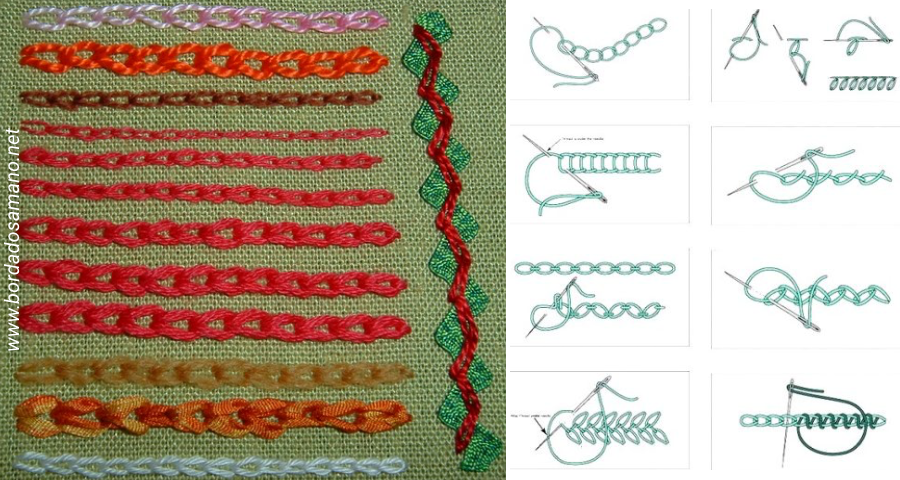
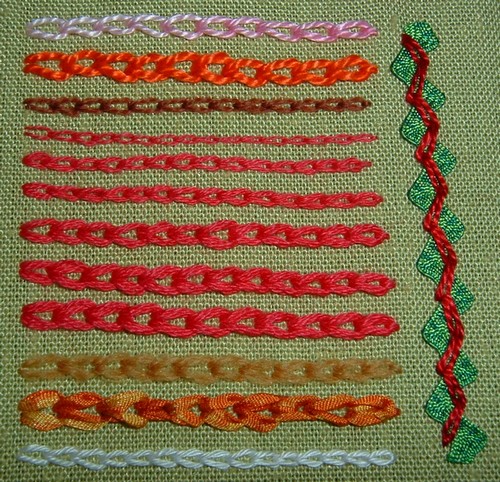
The chain stitch is one of the most basic embroidery stitches and one of the stitches with the most variations in the art of embroidery. Each link of the chain on the attached line can be straight, curved, stitched in lines next to each other to fill spaces, used as an outline for another shape, or as a single stem for a flower.
How to do it
The needle goes up through the fabric and back down through the same hole. The rolled part is caught in the next stitch to come back up through the fabric. The chain links can be left loose for a more open look or tightened down for a more solid line.
Additionally, using a fuzzier yarn will produce a chain link that appears more solid . Pearl cotton allows for a more open appearance.
Like the blanket stitch , this simple stitch belongs to the group of stitches that are formed with a loop below the needle point.
The stitch is worked vertically, from top to bottom, in a single motion . Before removing the needle, the thread is passed underneath to form the loop of the chain. To finish the stitch, a small securing stitch is made in the last chain.
Very important: the stitches have to be the same size and you cannot stretch the thread too much so that the final result looks good.
How to embroider step by step
Next, you can follow the step-by-step tutorial for Llueve Diamantina . It's very easy.
Chain stitch variations
Below you can see some variations of the stitch. This stitch has a lot of variations. Today we present some of the simplest to help you in your embroidery.
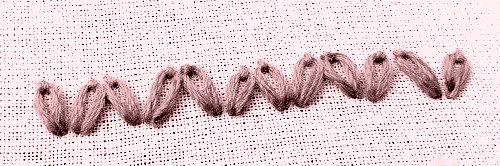
Zigzag chain stitch
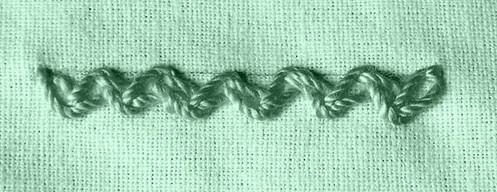
This embroidery stitch is the incorporation of the chain stitch in the form of a zigzag. In other words, this zigzag stitch is done between two parallel lines instead of one. Ideal for any embroidery project, this is more of a very decorative stitch. Below, you can see this embroidered stitch with just one stitch line to illustrate it. You can imagine a parallel stitch line on which it is embroidered. To make this stitch you only need to know how to do the normal stitch.
Topstitched chain stitch
To create this embroidery stitch, we add a backstitch in a different color over a row of basic chain stitches . This is another simple way to create a variation of the chain stitch.
Reverse chain stitch
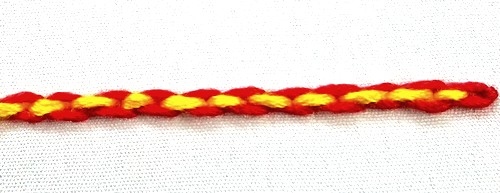
In this variation, it is not formed with a loop under the needle. The thread is intertwined below the previous chain. It results in a thicker chain than the normal chain.
Covered chain stitch
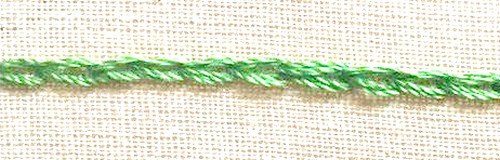
As with some of the other embroidery stitches we have seen so far, one of the simplest variations we can make on the chain stitch is the addition of a contrasting thread in another color that wraps around part of the stitches made previously.
Interlocking chain stitch
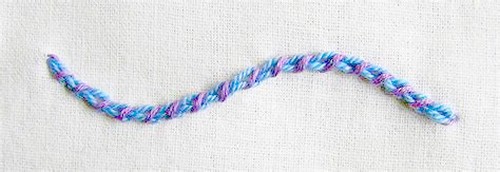
In this variation, interlaced threads are passed between the stitches previously made in the chain. For a better final result, you can use a contrasting colored thread to create the effect of a double chain.
separate chain stitch
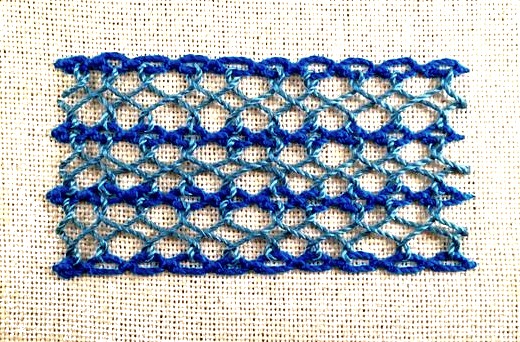
In this technique, the embroidery stitches are worked in rows or individually , but if worked in rows, they are not joined together. A very small space is left between them. Separate chain stitches can be used independently to embroider small leaves or flower petals. We can also embroider a row to create the base of a beautiful interlacing pattern.
And you, do you know any other variations of the chain stitch?
Related articles